



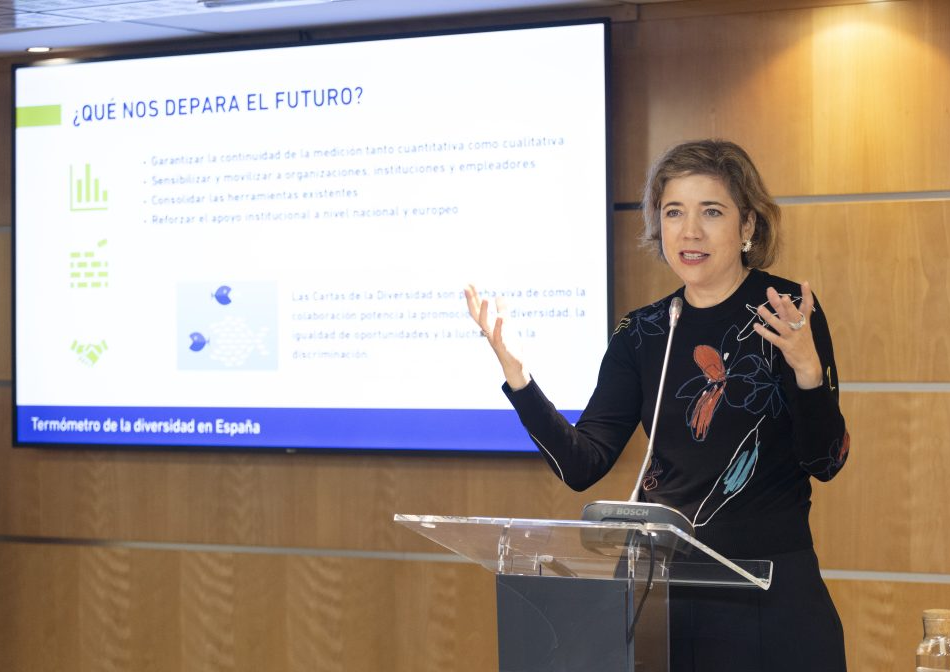
Fundación Diversidad presents the first “Diversity Barometer in Spain”, an in-depth analysis of how organizations are putting diversity and inclusion policies into practice.
Diversity in Spanish companies is progressing steadily, but there is still work to be done to turn commitments into measurable results. That’s the main takeaway from the report “Diversity Barometer in Spain. From Commitment to Action: How Do Organizations Comply with the Diversity Charter?”, presented this week by Fundación Diversidad at the Representation Office of the European Commission in Madrid.
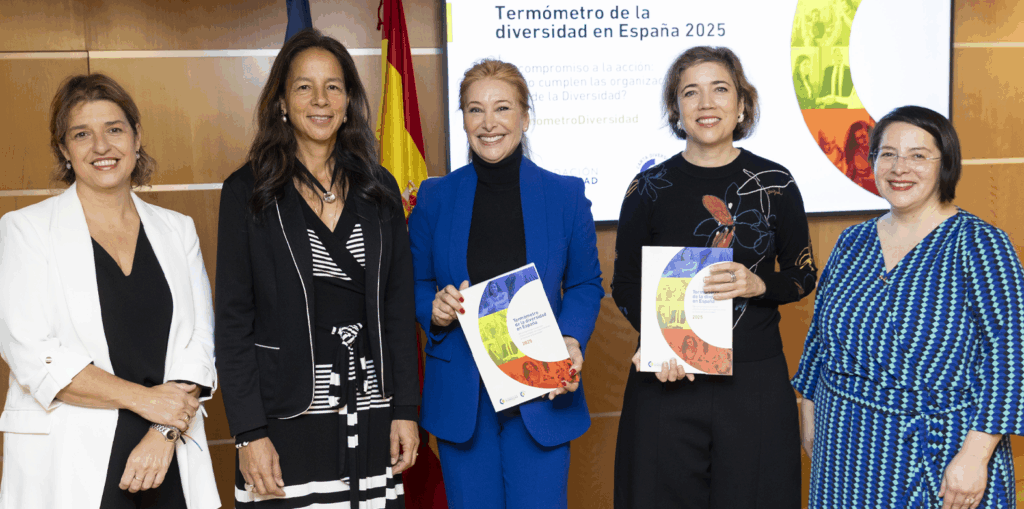
Font: Fundación Diversidad
The study, the first of its kind in Spain, analyzes the level of compliance with the ten principles of the Diversity Charter, based on data from nearly 1,000 organizations representing more than 1.4 million workers. The findings show both progress and gaps: strong institutional commitment, but uneven progress in how diversity, equity, and inclusion (DEI) are measured and managed.
Growing commitment and leadership from top management
82% of organizations have already incorporated DEI into their corporate values and codes of ethics. 9 out of 10 executives consider it a strategic priority.
“Diversity is no longer just a statement of intent, it is becoming part of business strategy,” said Sonia Río, General Director of Fundación Diversidad. “The next and most important step is to measure its impact and make DEI a core pillar of sustainability and innovation.”
A snapshot of diverse talent in Spain
The report offers a mixed picture of workforce composition:
- 46% of employees are women, but only 30% hold leadership roles.
- 2.5% are people with disabilities, slightly above the legal threshold (2%).
- 10% of staff are non-Spanish nationals (below the national average of 14.2%).
- 15.5% are under 30 and 13.1% are over 55, both 7 points below national averages.
- 62% of companies have specific measures in place for the LGTBI+ community.
Diversity at two speeds
The Diversity Barometer highlights a clear gap between large corporations and SMEs. While the former have structured strategies and dedicated teams, many small and medium-sized enterprises still act on intuition.
- 70% of large companies set concrete representation goals, compared to 40% of SMEs.
- Large companies are three times more likely to have employee resource groups (ERGs): 74% vs. 32%.
- Their capacity to measure impact is 20 percentage points higher.
“Big companies already view diversity as a strategic investment, while many SMEs still see it as an unstructured ideal. Closing that gap will be key to building a truly inclusive business culture,” the report concludes.
From talk to action
While 80% of companies surveyed have diversity plans or policies, only 59% regularly assess their outcomes, and just 9% link progress in inclusion to performance evaluations or incentives.
“The real challenge isn’t in saying you support inclusion—it’s in proving it with actions and measurable results,” said Teresa Viejo, President of Fundación Diversidad. “We must move from discourse to action. That’s the only way to achieve lasting cultural change.”
With over 1,600 signatories, the Diversity Charter (promoted in Spain by Fundación Diversidad with support from the European Commission) positions the country third in Europe in terms of commitment to equality and respect for difference in the workplace—behind only France and Germany, each with more than 6,000 signatories.
This high level of engagement reflects that diversity is becoming part of the DNA of Spanish business, and that organizations are increasingly aligned with European values of equity, inclusion, and equal opportunity.
More information is available on the Fundación Diversidad website.